
logo
✕
  • Home
  • Products
  • About Us
  • Contact
logo
  • Home
  • Products

    USB-C Cable

    • USB 4.0
    • USB 3.2
    • USB 3.0
    • USB 2.0

    Thunderbolt 5/4/3 Cable

    • Thunderbolt 5 Cable
    • Thunderbolt 4 Cable
    • Thunderbolt 3 Cable

    Audio/video Adapter Cable

    • DisplayPort To HDMI Cable
    • HDMI To DispalyPort Cable
    • HDMI To USB-C Cable
    • USB-C To DisplayPort Cable
    • USB-C To HDMI Cable

    USB-C Adapter

    • USB 4.0
    • USB 3.2
    • USB 3.0
    • USB 2.0
  • About Us
  • Contact
Published by eadmin on 2026-04-26
Categories
  • Blog
Tags

USB-C 100W vs 240W Charging in 2026: Which Power Standard Do You Actually Need?

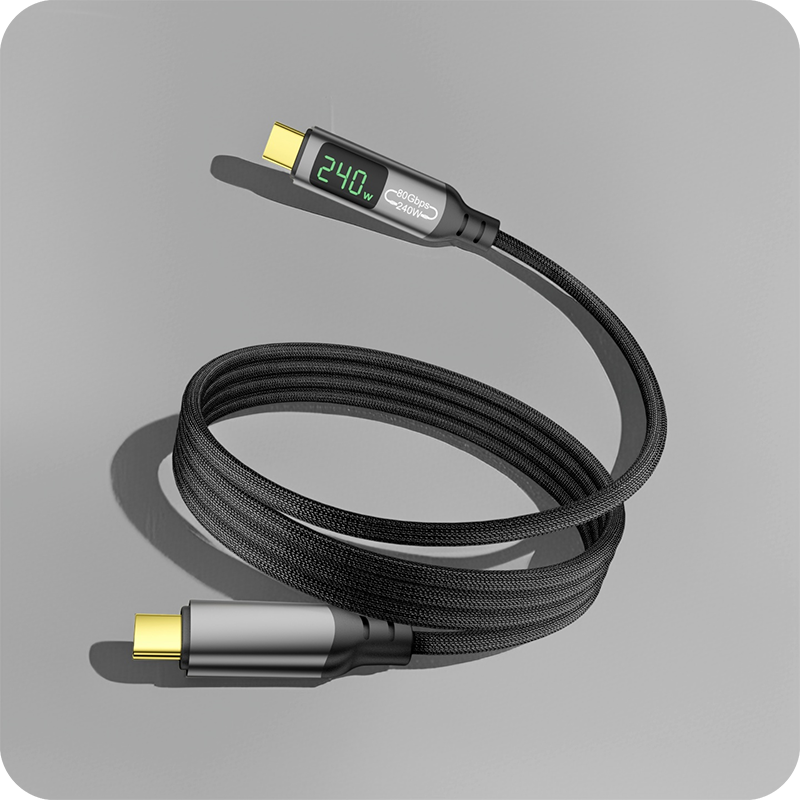
When USB Power Delivery 3.1 introduced Extended Power Range (EPR), it opened the door to 240W charging over USB-C. But most people are still using 65W or 100W chargers. Is 240W worth it? And more importantly 鈥?does your device actually need it?

The Power Landscape in 2026

In 2026, the vast majority of laptops charge at 65W or 100W. High-performance gaming laptops and mobile workstations have moved to 140W-240W USB-C charging, replacing traditional barrel connectors entirely. Meanwhile, smartphones typically charge at 18W-65W.

100W vs 240W: Specification Comparison

Specification 100W USB-C PD 240W USB-C EPR
Max Power 100W (20V/5A) 240W (48V/5A)
Voltage Steps 5V, 9V, 15V, 20V fixed 5V, 9V, 15V, 20V, 28V, 36V, 48V EPR
Cable Requirement Standard 5A USB-C cable EPR-certified cable (5A rated)
Laptop Support Most ultrabooks, tablets Gaming laptops, mobile workstations, some monitors
Guaranteed Charging Speed Full speed for most productivity laptops Full speed for high-power workstations

Do You Actually Need 240W?

Yes, If You Have…

  • A gaming laptop with RTX 5080 or similar high-TDP GPU
  • A mobile workstation (Dell Precision, HP ZBook) running at full load
  • A 4K/8K monitor that needs power delivery while driving the display

Probably Not, If You Have…

  • A standard ultrabook (65W-96W charge rate)
  • A tablet or 2-in-1 device
  • A smartphone that caps at 45W regardless

The Cable Matters

240W EPR requires specifically certified cables that can handle 5A at up to 48V. Standard 100W cables are rated for 5A at 20V (100W) but may not safely handle the higher voltages of EPR. Always check for EPR certification on cables rated above 100W.

Conclusion

For most users, 100W USB-C charging is more than sufficient and offers the best balance of compatibility, cable availability, and cost. But as gaming laptops and workstations continue to adopt USB-C EPR charging, 240W is becoming increasingly relevant. Shop certified USB-C cables at USB-C Factory for all power levels.

eadmin
eadmin

Related posts

2026-05-08

USB-C Cable for Drone and Robotics 2026: Lightweight High-Speed Data


Read more
2026-05-08

USB-C Cable for Data Center and Server Room 2026: High-Density Power and Data


Read more
2026-05-08

USB-C Cable Care and Maintenance Guide 2026: Extend Cable Lifespan


Read more

Leave a Reply Cancel reply

Your email address will not be published. Required fields are marked *

Navigation

  • About
  • Contact

Products

  • USB-C Adapter
  • Thunderbolt 5/4/3 Cable
  • Audio/video Adapter Cable
  • USB-C Cable

Contacts

+86 13242969135
Sales@eilinks.com
Chashan Town, Dongguan City, Guangdong , China
© Dongguan Eilinks Eletronics Co.,Ltd All Rights Reserved
  • Consent
  • Details
  • About Cookies

This website uses cookies

We use cookies to personalise content and ads, to provide social media features and to analyse our traffic. We also share information about your use of our site with our social media, advertising and analytics partners who may combine it with other information that you’ve provided to them or that they’ve collected from your use of their services.

Necessary

Necessary cookies help make a website usable by enabling basic functions like page navigation and access to secure areas of the website. The website cannot function properly without these cookies.

Analytics & Performance

Statistic cookies help website owners to understand how visitors interact with websites by collecting and reporting information anonymously.

Marketing

Marketing cookies are used to track visitors across websites. The intention is to display ads that are relevant and engaging for the individual user and thereby more valuable for publishers and third party advertisers.

Cookies are small text files that can be used by websites to make a user's experience more efficient.

The law states that we can store cookies on your device if they are strictly necessary for the operation of this site. For all other types of cookies we need your permission. This means that cookies which are categorized as necessary, are processed based on GDPR Art. 6 (1) (f). All other cookies, meaning those from the categories preferences and marketing, are processed based on GDPR Art. 6 (1) (a) GDPR.

This site uses different types of cookies. Some cookies are placed by third party services that appear on our pages.

You can at any time change or withdraw your consent from the Cookie Declaration on our website.

Learn more about who we are, how you can contact us and how we process personal data in our Privacy Policy.

Please state your consent ID and date when you contact us regarding your consent.

Deny Customize Allow selected Allow all