
USB-C Cable AWG Guide: Choosing the Right Wire Gauge for Power and Data in 2026
AWG (American Wire Gauge) is the most important specification that most buyers overlook when sourcing USB-C cables. The wire gauge directly determines how much power a cable can safely carry, how much voltage drop occurs over distance, and how thick and flexible the cable feels. A thinner cable may look sleek, but an undersized gauge will cause overheating, slow charging, and potential safety hazards. Eilinks Electronics, a leading USB-C cable manufacturer, provides this comprehensive guide to help you select the correct AWG for every application.
Understanding AWG: Lower Number Means Thicker Wire
The AWG system is counterintuitive: a lower AWG number means a thicker wire with greater current-carrying capacity. For example, 20 AWG wire is thicker than 28 AWG wire. In USB-C cables, the most common wire gauges for power conductors are:
- 28 AWG: Ultra-thin, for low-power data cables (up to 3A at 20V = 60W)
- 26 AWG: Standard for most 60-100W charging cables
- 24 AWG: Enhanced for high-power 100-140W applications
- 22 AWG: Heavy-duty for 140-240W EPR cables
- 20 AWG: Maximum power delivery, industrial and automotive grade
AWG and Power Delivery: The Critical Relationship
USB Power Delivery operates at voltages from 5V to 48V (up to 240W USB-C with EPR at 48V/5A). At higher voltages, thinner wires can carry the same power because current is lower (Power = Voltage x Current). However, conductor gauge still matters for voltage drop, heat dissipation, and mechanical durability.
| Power Level | Voltage/Current | Min AWG (VBus) | Typical Cable OD |
|---|---|---|---|
| 15W (5V/3A) | 5V / 3A | 28 AWG | 3.0mm |
| 60W (20V/3A) | 20V / 3A | 26 AWG | 3.5mm |
| 100W (20V/5A) | 20V / 5A | 24 AWG | 4.0mm |
| 140W (28V/5A) | 28V / 5A | 22 AWG | 4.5mm |
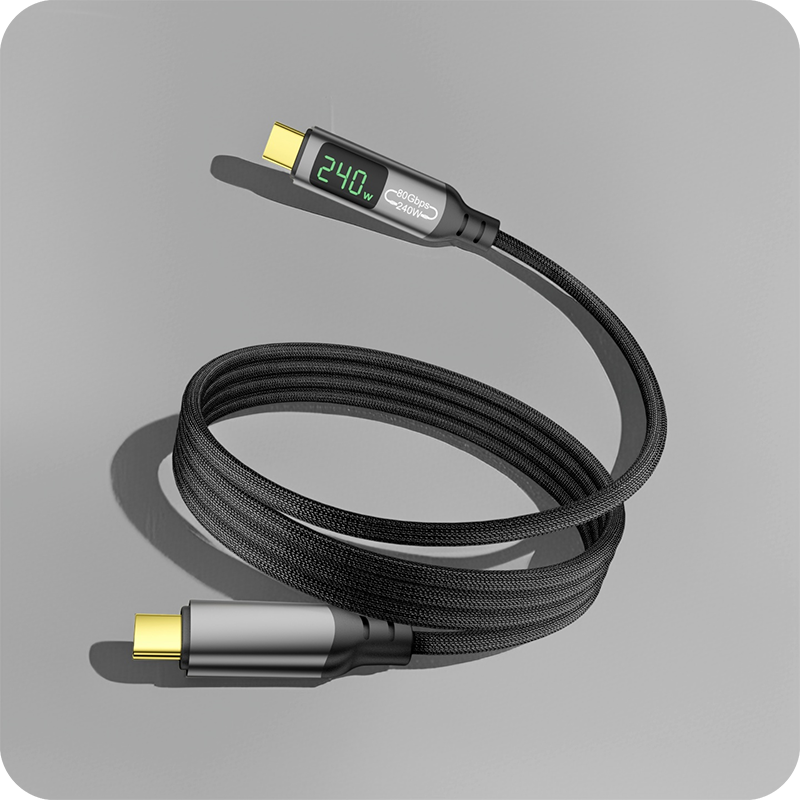
| 240W (48V/5A) EPR | 48V / 5A | 20-22 AWG | 5.0-5.5mm |
AWG and Data Speed: It Is Not Just About Power
Data conductors in USB-C cables also follow AWG ratings, but the relationship is different. For high-speed data, the wire gauge affects signal integrity and maximum cable length rather than raw throughput. Thinner data conductors (30-32 AWG) are common in high-speed differential pairs because they reduce crosstalk between adjacent wires.
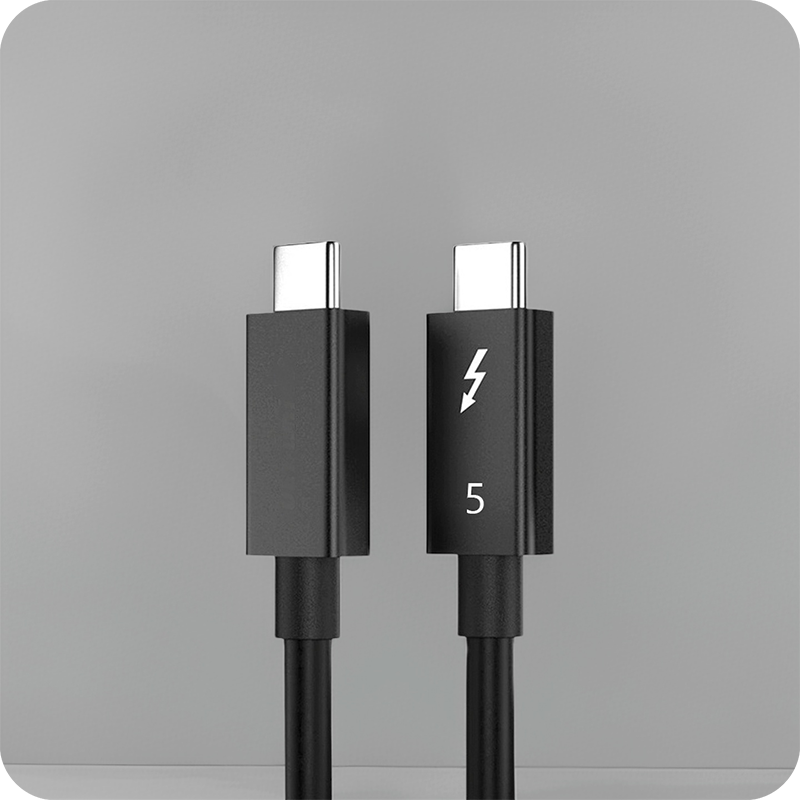
A USB4 cable at 80Gbps uses very fine gauge twisted pairs (typically 32-34 AWG) for signal wires, wrapped in heavy shielding. The overall cable diameter is determined more by the shielding layers than by the conductor gauge. This is why a Thunderbolt 5 cable can be thicker than a basic power cable even though its power conductors may be similar gauge.
How to Verify Cable AWG
When sourcing from a USB-C cable manufacturer, always request the wire gauge specification for both VBus (power) and data conductors. Key verification methods include:
- Check the product specification sheet for conductor AWG ratings
- Measure cable outer diameter (thicker generally means heavier gauge for power)
- Cross-section microscopy to count conductor strands and measure strand diameter
- Request USB-IF certification documentation which includes electrical testing
Eilinks Electronics provides complete spec sheets with AWG ratings, conductor material (copper or tinned copper), and strand counts for all USB-C cable products.
AWG for Specific Applications
Smartphone Charging (18-27W)
Most smartphones charge at 9V/2A to 9V/3A. A 28 AWG VBus conductor is sufficient for these power levels. However, for faster charging at 27W or higher, 26 AWG provides better thermal margin and longer cable life. A USB-C Cable with 28/30 AWG construction is the thinnest and most flexible option for portable use.
Laptop Charging (60-100W)
Laptops typically require 60-100W USB-C PD. Use 24-26 AWG VBus conductors for reliable 60W delivery and 22-24 AWG for 100W. Avoid ultra-thin cables labeled “100W” with 28 AWG conductors, as they may overheat during sustained full-power charging.
Gaming Laptops and Workstations (140-240W)
High-performance gaming laptops and mobile workstations demand 140W or more. An EPR cable rated for 240W requires 20-22 AWG VBus conductors to safely handle 5A at 48V. These cables are noticeably thicker but necessary for safe, efficient high-power delivery. Eilinks Electronics manufactures EPR-rated cable products with 20 AWG conductors for maximum power delivery applications.
Cable Length and AWG Interaction
Longer cables need thicker conductors to compensate for voltage drop. For every meter of cable length, voltage drops proportionally to the wire resistance. At 20V/5A (100W), a 2-meter cable with 28 AWG conductors may lose 1-2V, resulting in the device receiving only 90-95W. Upgrading to 24 AWG cuts the voltage drop in half.
Frequently Asked Questions
Does Thicker Always Mean Better for USB-C Cables?
Not necessarily. Thicker cables have heavier gauge conductors for power delivery, but for data-only or low-power applications, thinner cables are more practical. A USB 2.0 Cable for a keyboard does not need heavy power conductors. Match the gauge to your actual power requirement.
Can a 60W Cable Safely Charge a 100W Laptop?
Yes, but the laptop will only receive up to 60W. USB PD negotiation ensures devices only draw the power the cable can safely deliver. However, a properly rated cable matching your device’s maximum power is recommended for fastest charging.
What AWG Is Needed for USB4 80Gbps?
For the data conductors in a USB4 cable, gauge is less critical than shielding and signal pair construction. Typical data pairs use 32-34 AWG. The overall cable thickness comes from shielding, not conductor gauge. For power conductors carrying simultaneous PD, follow the standard power gauge guidelines.
Are Tinned Copper Conductors Better Than Bare Copper?
Tinned copper offers better corrosion resistance and easier soldering, making it preferred for industrial and marine applications. Bare copper has slightly lower resistance (approximately 1-2% better conductivity). For most consumer applications, the difference is negligible. Eilinks Electronics offers both options depending on the application environment.
How Does AWG Affect Cable Flexibility?
Lower AWG (thicker wire) reduces flexibility. A 20 AWG cable is significantly stiffer than a 28 AWG cable. Stranded conductors (many fine wires bundled together) improve flexibility compared to solid conductors of the same gauge. For applications requiring frequent bending, choose a cable with higher strand count in the power conductors.
Conclusion
AWG is the single most important specification for USB-C cable power delivery capability. Choosing the correct wire gauge ensures safe, efficient charging at your required power level, while also affecting cable thickness and flexibility. For high-power applications like 240W EPR charging, 20-22 AWG conductors are mandatory. For everyday smartphone charging, 26-28 AWG provides the best balance of performance and portability. Always verify AWG specifications with your USB-C cable manufacturer, and demand proper certification documentation. Eilinks Electronics provides complete AWG specifications and testing data for all USB-C cable products.
