
USB-C Cable Material and Build Quality Guide 2026: What Makes a Premium Cable
Not all USB-C cables are created equal. The difference between a cable that lasts for years and one that fails within months lies in the materials and manufacturing processes used during production. As a direct USB-C cable manufacturer, Eilinks Electronics controls every aspect of cable construction, from raw material selection to final quality testing. This guide reveals the materials, construction techniques, and quality indicators that separate premium USB-C cables from budget alternatives.
Internal Conductor Materials
The conductor is the heart of any cable, carrying electrical signals and power between devices. USB-C cables use copper conductors, but the purity and quality of that copper vary significantly:
Oxygen-Free Copper (OFC)
Oxygen-free copper (99.95% to 99.99% purity) is the gold standard for USB-C cable conductors. Removing oxygen impurities from copper reduces electrical resistance, improves signal transmission quality, and prevents internal oxidation that degrades performance over time. All cables manufactured by Eilinks Electronics use oxygen-free high-conductivity (OFHC) copper for maximum performance and longevity.
Tinned Copper
Tinned copper applies a thin tin coating over the copper conductor, providing excellent corrosion resistance for cables used in harsh environments. While slightly less conductive than bare OFC, tinned copper is preferred for industrial, marine, and outdoor applications where moisture and chemical exposure are concerns.
Copper-Clad Aluminum (CCA)
CCA conductors use an aluminum core with a thin copper coating. These are significantly cheaper than pure copper but have higher electrical resistance and lower current-carrying capacity. CCA cables are commonly found in ultra-budget products and should be avoided for any application requiring reliable high-speed data or high-wattage charging. No reputable USB-C cable manufacturer uses CCA for power or data conductors in certified products.
| Conductor Type | Purity | Conductivity | Corrosion Resistance | Cost | Recommended |
|---|---|---|---|---|---|
| OFHC Copper | 99.99% | 100% IACS | Good | High | Premium cables |
| OFC Copper | 99.95% | 101% IACS | Good | Medium-High | Quality cables |
| Tinned Copper | 99.9% | 97% IACS | Excellent | Medium | Industrial/marine |
| CCA | N/A | 65-70% IACS | Poor | Low | Avoid |
Insulation and Jacket Materials
Outer Jacket Materials
The outer jacket protects internal components from physical damage, moisture, and chemical exposure. Common materials include:
| Material | Flexibility | Durability | Temperature Range | Best For |
|---|---|---|---|---|
| PVC | Good | Moderate | -20 to 80 degrees C | Budget cables |
| TPE | Excellent | Good | -40 to 80 degrees C | Consumer cables |
| TPU | Very Good | Excellent | -40 to 90 degrees C | Premium cables |
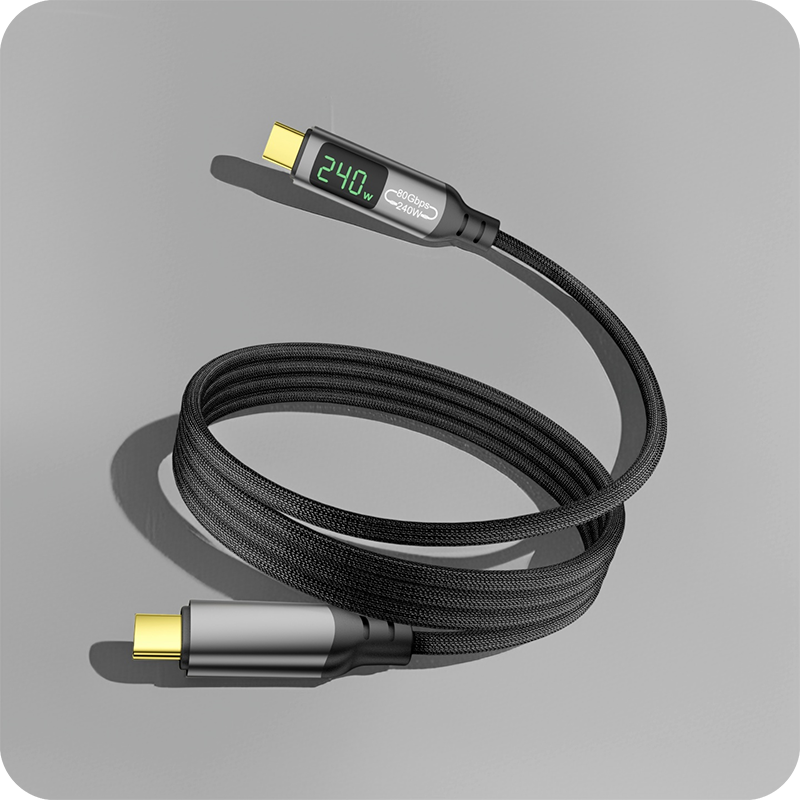
| Braided Nylon | Good | Excellent | Varies by inner jacket | Professional/tough use |
| LSZH | Moderate | Good | -20 to 70 degrees C | Public buildings |
Eilinks Electronics primarily uses TPE and TPU for consumer products and braided nylon for professional-grade cables. Low-smoke zero-halogen (LSZH) jackets are available for building installations where fire safety codes require halogen-free materials.
Internal Insulation
Each individual conductor inside a USB-C cable requires insulation to prevent short circuits and signal crosstalk. High-quality cables use specialized dielectric materials:
- PTFE (Teflon): Excellent dielectric properties, high temperature tolerance. Used in premium high-speed cables including USB4 cable products.
- PE (Polyethylene): Good balance of properties, cost-effective for mid-range cables.
- PVC: Budget option with adequate but not optimal dielectric properties.
Shielding for Signal Integrity
Shielding prevents electromagnetic interference (EMI) from corrupting data signals and power delivery. USB-C cables carrying high-speed data signals require increasingly sophisticated shielding:
Shielding Types
| Shield Type | Construction | EMI Protection | Used In |
|---|---|---|---|
| None | No shielding | None | USB 2.0 cables under 1m |
| Foil (STP) | Aluminum foil wrap | Good | USB 3.2 cables |
| Braid | Braided copper mesh | Very Good | USB 3.2 Gen 2 cables |
| Double (Foil + Braid) | Both foil and braid layers | Excellent | USB4, Thunderbolt cables |
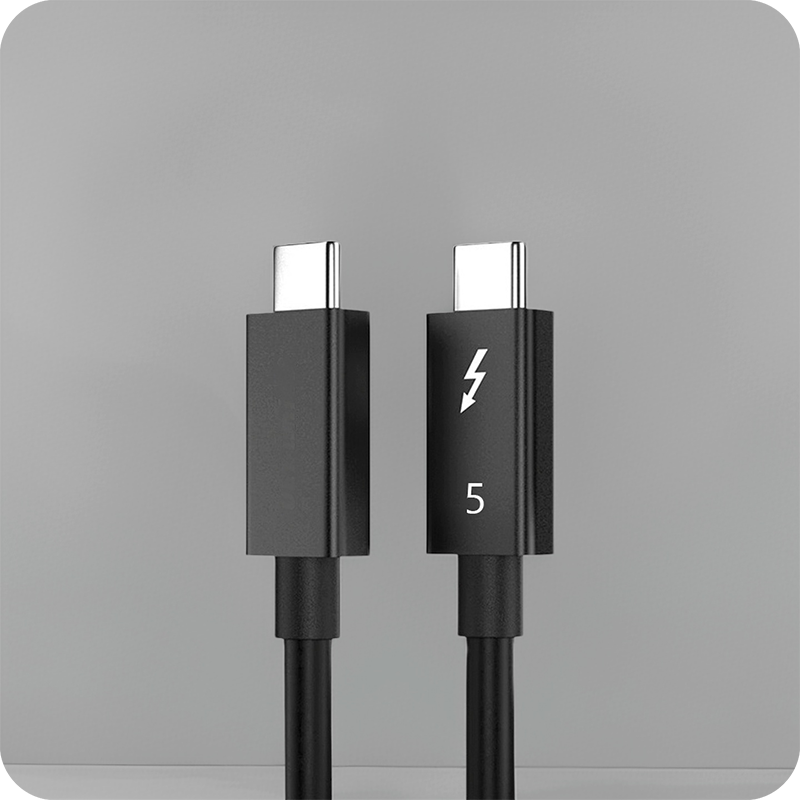
| Triple Shield | Individual pair + foil + braid | Maximum | Thunderbolt 5 cable, EPR cables |
For USB4 and Thunderbolt cables operating at 40-80 Gbps, triple shielding is essential to maintain signal integrity at high frequencies. Eilinks Electronics applies triple shielding to all USB4 and Thunderbolt cable products, with additional individual pair shielding for differential signal pairs.
Connector Construction
The USB-C connector is the most mechanically stressed component of any cable. Premium connector construction includes:
Connector Shell Materials
- Stainless steel: Maximum durability, used in premium and industrial cables
- Zinc alloy die-cast: Good durability at lower cost, most common in quality consumer cables
- ABS plastic: Budget option, adequate for light use but prone to cracking
Contacts and Plating
Connector pins (contacts) must maintain reliable electrical connection over thousands of insertion cycles. Premium contacts use:
- Base material: Phosphor bronze or beryllium copper for spring-like contact force
- Plating: 30 microinches of gold over nickel underplate for corrosion resistance
- Contact force: Precision-stamped contacts with consistent insertion and extraction force
Strain Relief Design
The strain relief boot is where the cable jacket transitions to the connector, and it is the most common failure point in USB-C cables. Quality strain relief design includes:
- Molded strain relief: One-piece construction where the boot is overmolded onto both the cable jacket and connector shell
- Internal bend restrictor: A rigid sleeve inside the strain relief that prevents sharp cable bending at the connector junction
- Stress-relief grooves: Flexible grooves in the strain relief boot that distribute bending forces across a larger area
Eilinks Electronics stress-tests all strain relief designs to 10,000+ bending cycles at 90 degrees, exceeding the USB-IF minimum requirement of 5,000 cycles.
Manufacturing Quality Control
The manufacturing process determines whether a cable meets its specifications consistently. Key quality control steps include:
| QC Step | What It Tests | How It Is Performed |
|---|---|---|
| Continuity test | All pins properly connected | Automated pin-by-pin testing |
| Hi-pot test | Insulation integrity at high voltage | 500V-1000V applied between conductors |
| Signal integrity test | Data transmission quality | Eye diagram analysis at rated speed |
| PD negotiation test | Power delivery protocol | Full PD 3.1 negotiation with test equipment |
| Pull strength test | Connector retention force | 15N minimum pull force |
| Bend cycle test | Strain relief durability | 10,000+ cycles at 90 degrees |
Every cable from Eilinks Electronics undergoes 100% functional testing before packaging. We maintain detailed quality records for each production batch, enabling full traceability from raw materials to finished product.
OEM Custom Material Options
For businesses seeking custom USB-C cable solutions, Eilinks Electronics offers extensive material customization:
- Conductor gauge selection: 28 AWG to 16 AWG depending on power and current requirements
- Jacket material and color: TPE, TPU, PVC, braided nylon in any Pantone color
- Connector finish: Matte, glossy, metallic, or soft-touch in custom colors
- Shielding level: Single shield to triple shield based on speed requirements
- Fire rating:
LSZH, VW-1, or IEC 60332 rated for commercial installations Frequently Asked Questions
Does cable material really affect charging speed?
Yes. The conductor material and gauge directly determine how much current a cable can safely carry. A cable with OFC copper and adequate conductor gauge (20 AWG or thicker for power conductors) delivers full rated charging speed. A cable with CCA conductors or undersized wire gauge will heat up under load, causing the charging controller to reduce current, resulting in significantly slower charging. For 240W USB-C EPR charging, only cables with properly rated OFC conductors and 48V-rated insulation should be used.
Are braided cables better than rubber/PVC cables?
Braided nylon cables offer superior durability and tangle resistance compared to standard PVC or TPE jackets. They resist abrasion, pet chewing, and?? wear significantly better. However, braided cables can be slightly stiffer and heavier than TPE alternatives. For professional, gaming, or heavy-use applications, braided nylon is recommended. For lightweight everyday carry, TPE offers better flexibility at slightly lower durability.
What is the best USB-C cable material for outdoor use?
For outdoor applications, choose cables with TPU or LSZH jackets, tinned copper conductors for corrosion resistance, and UV-resistant jacket material. IP67-rated cables with sealed connectors provide complete protection against dust and water immersion. Eilinks Electronics manufactures custom outdoor-rated USB-C cables for industrial, marine, and construction applications with enhanced environmental protection.
How can I tell if a USB-C cable uses quality materials?
Visual indicators include: smooth and consistent jacket surface, firm strain relief with no gap between jacket and connector, properly centered connector pins, and clear labeling on the jacket. For definitive verification, ask the manufacturer for material specification sheets showing conductor type, gauge, shielding construction, and jacket material. Reputable manufacturers like Eilinks Electronics provide detailed specifications and third-party test reports for all products.
Does shielding affect USB-C cable flexibility?
Yes, additional shielding layers make cables slightly stiffer and less flexible. A triple-shielded Thunderbolt 5 cable will be stiffer than a single-shielded USB 2.0 Cable. However, premium manufacturers use thin, flexible shielding materials and optimize the cable lay design to maintain reasonable flexibility even with extensive shielding. The tradeoff between shielding and flexibility is worthwhile for high-speed cables where signal integrity is paramount.
Need Premium USB-C Cables?Eilinks Electronics is a leading USB-C cable manufacturer with 15+ years of experience in OEM and ODM production.
